Disclosure: This post contains affiliate links. We may earn a small commission if you purchase through our links, at no extra cost to you.
We Thought We Were Prepared
We had a brand-new tent. We had sleeping bags rated to 20°F. We had a camp stove, a cooler full of food, and a playlist of campfire songs downloaded for the drive. We had researched the campground, read the reviews, and packed what felt like everything we could possibly need.
We were not prepared.
Our first family camping trip — two nights at a campground on the Blue Ridge Parkway in North Carolina — was a masterclass in everything we didn't know about camping with kids. The tent took 45 minutes to pitch in fading light. Our youngest refused to sleep in her sleeping bag. The camp stove ran out of fuel on the second morning. And at 2 a.m. on night one, we discovered that a headlamp is only useful if you can actually find it in the dark.
But here's the thing: it was also one of the best trips we've ever taken as a family. Our kids still talk about it. They want to go back. And we learned more in those two nights than we could have from any amount of research.
This is the honest account of that trip — every mistake, every unexpected moment, and everything we'd do differently. If you're planning your first family camping trip, read this before you pack.
The Gear We Got Right
Let's start with the wins, because there were some. The sleeping bags were excellent — the kids were warm even when the temperature dropped to 48°F overnight, which we hadn't fully anticipated in late September. We'd borrowed a family-sized tent from a neighbor, which turned out to be the right call: our original plan to use a two-person tent would have been a disaster.
The one gear decision that saved us was the headlamps. We had bought each kid their own Black Diamond Kids' Wiz Kid Headlamp in the weeks before the trip. They wore them constantly — on the trail, around the campsite, and in the tent at bedtime. Our oldest used his to read after lights-out. Our youngest used hers to inspect every bug she found. The headlamps gave the kids independence and made the whole experience feel more like an adventure and less like a chore.
The hydration packs were another good call. We'd gotten each kid a Osprey Kids' Moki Hydration Pack for the trip. They carried their own water, their own snacks, and a few small personal items. Having their own pack gave them ownership of the experience in a way that mattered — they weren't just passengers, they were participants.
The Gear We Got Wrong
The camp stove situation was entirely our fault. We'd used the stove on a previous car camping trip and assumed the fuel canister was still mostly full. It wasn't. We ran out of fuel on the second morning, which meant cold instant oatmeal for breakfast and a very unhappy family. The lesson: always bring a spare fuel canister, always check what you have before you leave, and always have a backup plan for hot food.
We also brought too much food and not enough snacks. We packed elaborate meals — pasta with sauce, scrambled eggs, foil-packet dinners — and then discovered that cooking over a camp stove with three kids underfoot is significantly harder than cooking in a kitchen. The meals that worked were simple: hot dogs on sticks over the fire, peanut butter sandwiches, and trail mix. The elaborate meals mostly didn't happen.
What we should have packed more of: Country Archer Mini Beef Sticks, Justin's Peanut Butter Squeeze Packs, and Nuun Sport Electrolyte Tablets. These are the snacks that actually got eaten, kept the kids fueled on the trail, and required zero preparation. On future trips, we pack these in bulk and simplify everything else.
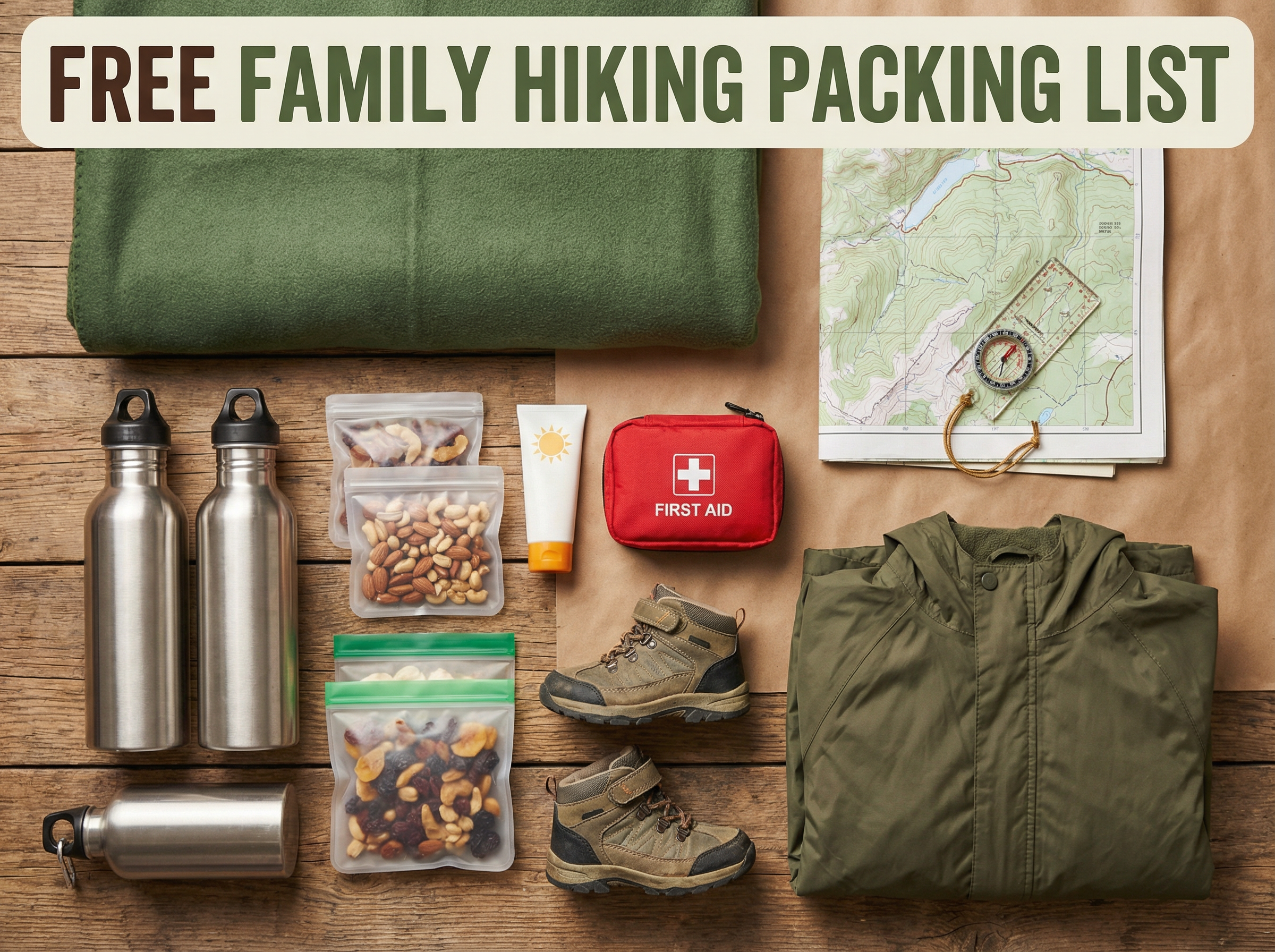
Planning your first family camping trip? Before you pack a single thing, download our free Family Hiking Checklist. It covers everything you need for the trail — what to wear, what to carry, what to eat, and how to keep kids safe and happy outdoors. It's the checklist we wish we'd had before our first trip.
The Night Everything Went Wrong
Night one was the real test. We'd gotten the tent up just before dark, fed the kids dinner (hot dogs — the right call), and started a campfire. For about two hours, everything was perfect. The kids roasted marshmallows. We told stories. The stars came out. It was exactly what we'd imagined camping would be.
Then bedtime arrived.
Our youngest, who was four at the time, decided that sleeping in a sleeping bag was non-negotiable. She wanted her blanket from home. She wanted her pillow from home. She wanted her stuffed rabbit from home. She did not want to be in a tent in the woods. For about 45 minutes, she cried. We tried everything: stories, songs, promises of pancakes in the morning. Nothing worked.
What finally worked: we let her sleep between us, wrapped in both our sleeping bags unzipped and laid flat like blankets. It wasn't ideal for our sleep, but it worked. And by the second night, she was fine in her own sleeping bag — she just needed one night to adjust to the new environment.
The lesson we took from this: kids need transition time. The first night of anything new is always the hardest. Don't judge the whole experience by night one.
What the Kids Actually Loved
Here's what surprised us most: the things the kids loved most about camping had nothing to do with the activities we'd planned.
They loved the headlamps. They wore them from the moment it got dark until we made them take them off to sleep. The simple act of having their own light source — their own way of navigating the dark — felt like genuine independence to them.
They loved the fire. We spent two hours each evening just sitting around the campfire, talking, roasting things, watching the flames. No screens. No agenda. Just fire. Our oldest said it was his favorite part of the whole trip.
They loved the creek near our campsite. We hadn't planned for creek time — it just happened on our first morning walk. The kids spent three hours turning over rocks, catching crayfish, and building small dams. It was completely unstructured, completely screen-free, and completely magical.
They loved waking up outside. The first morning, our youngest unzipped the tent door, looked out at the trees, and said: "We're still here." She was delighted. That moment — that simple recognition that the world outside was still there, still beautiful, still waiting — was worth every difficult moment of the trip.
The Trail Day: What Worked and What Didn't
On our second day, we did a 3-mile out-and-back trail near the campground. It was rated "easy to moderate" — which, with a four-year-old, meant "moderate to hard." We took it slow, stopped frequently, and let the kids set the pace.
The hydration packs were essential. Each kid carried their own water and snacks, which meant fewer stops for "I'm hungry" and "I'm thirsty" and more actual hiking. Our middle child, who was seven, used his Osprey Moki pack to carry his nature journal and a small pair of binoculars. Having his own gear made him feel like a real hiker, not just a kid being dragged along.
We'd also brought Black Diamond Kids' First Strike Trekking Poles for our oldest, who was ten. He used them on every downhill section and said they made a real difference on the rocky terrain. Our middle child wanted poles too — noted for next time.
The snack strategy was critical. Every 30–40 minutes, we stopped for a snack break. Mission Meats Mini Beef Sticks and Justin's Peanut Butter Squeeze Packs were the favorites — high protein, no mess, and the kids actually looked forward to them. We also mixed Nuun electrolyte tablets into the water bottles, which kept everyone hydrated without the sugar crash of sports drinks.
The trail itself was beautiful — views of the Blue Ridge mountains, a waterfall about halfway through, and enough wildlife (a deer, two chipmunks, and one very bold squirrel) to keep the kids engaged. We finished in about two hours, which felt like exactly the right amount.
What We'd Do Differently
Arrive earlier in the day.
We arrived at the campground at 5 p.m., which gave us about 90 minutes of daylight to set up camp. That was not enough time. On future trips, we aim to arrive by 2 p.m. at the latest — enough time to set up without rushing, explore the campsite, and let the kids run around before dinner.
Practice the tent at home first.
We set up our tent for the first time in a dark campground. This was a mistake. On future trips, we set up the tent in the backyard first — both to make sure we know how it works and to let the kids get familiar with it before the actual trip.
Bring one comfort item per kid.
The sleeping bag resistance from our youngest was entirely predictable in hindsight. On future trips, each kid gets to bring one comfort item from home — a stuffed animal, a small blanket, whatever they need to feel secure in a new environment. This is a small concession that prevents a lot of bedtime drama.
Simplify the food.
Hot dogs, peanut butter sandwiches, instant oatmeal, and trail mix. That's the camping food menu now. We don't try to cook elaborate meals over a camp stove anymore. Simple food means less stress, less cleanup, and more time for the things that actually matter.
Build in one completely unstructured day.
The creek day — the day we had no plan and just wandered — was the best day of the trip. On future camping trips, we always build in at least one day with no agenda. Just a campsite, some woods, and whatever the kids decide to do.
Would We Do It Again?
Yes. Without hesitation.
Our first family camping trip was imperfect in almost every logistical way. The tent took too long to pitch. The stove ran out of fuel. The four-year-old cried at bedtime. None of it mattered. What mattered was the campfire on the first night, the creek on the second morning, the deer on the trail, and the look on our youngest's face when she unzipped the tent and realized the mountains were still there.
Camping with kids isn't about having the perfect gear or the perfect campsite or the perfect weather. It's about getting outside, getting uncomfortable, and discovering that your family is more capable than you thought. Every mistake is a story. Every difficult moment is a lesson. And every morning you wake up in the woods is a morning your kids will remember.
Start simple. Start close to home. Start before you feel ready. The mountain has been waiting for your family.